I/O modules
AXO-008 — ST7735 1.8" SPI TFT carrier PMOD module
Catalog #8 in the AruviX output line, level L4. Socketed carrier for the ubiquitous 1.8" 128×160 ST7735 SPI TFT breakout — same pattern as the sensor line's ultrasonic (axs-021) and GPS (axs-046) carriers, because ST7735 has no stock KiCad assets (documented deferral).
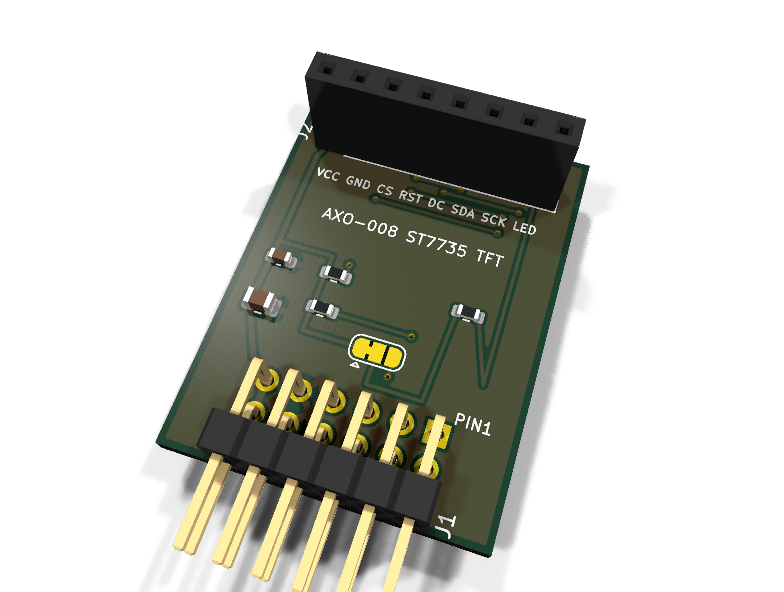
Circuit review & bench-test guide →
Components#
Every placed component, with the reason it is on the board. Extracted directly from the schematic, so this cannot drift from the design.
| Ref | Value | What it does on this board | Part number | Footprint |
|---|---|---|---|---|
C1 |
100nF 16V X7R | Socket decoupling | GRM188R71C104KA01DMurata |
C_0603_1608Metric |
C2 |
10uF 10V X5R | Bulk reservoir for display + backlight at the socket | GRM21BR61A106KE19LMurata |
C_0805_2012Metric |
J1 |
PMOD PLUG 2x6 | PMOD peripheral plug (Digilent spec 1.2) | not selected generic |
PinHeader_2x06_P2.54mm_Horizontal |
J2 |
ST7735 SOCKET (1x8) | Socket for the common 1.8in ST7735 SPI TFT breakout | not selected generic |
PinSocket_1x08_P2.54mm_Vertical |
JP1 |
BL: 3V3 / PWM | Backlight source select: 1-2 (default) always-on 3V3, 2-3 PWM from PMOD 9 | — | SolderJumper-3_P1.3mm_Bridged12_RoundedPad1.0x1.5mm |
R1 |
10k | ~RESET pull-up: display out of reset until the host drives it low | RC0603FR-0710KLYageo Datasheet ↗ |
R_0603_1608Metric |
R2 |
10k | ~CS idle pull-up so an unconfigured host cannot clock in garbage | RC0603FR-0710KLYageo Datasheet ↗ |
R_0603_1608Metric |
R3 |
100R | Backlight LED series resistor (~20 mA into the breakout's LED pin) | RC0603FR-07100RLYageo Datasheet ↗ |
R_0603_1608Metric |
Signals#
Net labels used in the schematic, which are also the names the HDL top level should use.
3V3 BL_PWM BL_SRC GND LED_PIN MOSI SCK TFT_CS TFT_DC TFT_RST
Production status#
| Schematic ERC | 0 violations |
|---|---|
| PCB layout | complete |
| DRC | 0 violations |
| Fab package | exported (24 gerbers + drill + CPL + BOM) |
| Fabricated | no — design stage only |
Source: boards/io-modules/axo-008-tft
Catalog #8 in the AruviX output line (../README.md), level L4. Socketed carrier for the ubiquitous 1.8" 128×160 ST7735 SPI TFT breakout — same pattern as the sensor line's ultrasonic (axs-021) and GPS (axs-046) carriers, because ST7735 has no stock KiCad assets (documented deferral in ../README.md).
Status: schematic generated, ERC clean (0/0), netlist reviewed. PCB layout not started. Not released.
What it teaches#
A write-only SPI display: init-command sequences, DC (data/command) framing, RGB565 pixel pushing at up to ~15 MHz SCK — the FPGA draws with no framebuffer chip in the way. Terminal, gauges, sprite demos.
Design#
- J2 = 1×08 pin socket in the most common breakout order:
1 VCC 2 GND 3 CS 4 RESET 5 A0/DC 6 SDA 7 SCK 8 LED. ORDER-CHECK WARNING (on the schematic too): 1.8" clones vary — some swap VCC/GND or move LED. Verify your breakout's silkscreen against this map before soldering the socket or plugging in. - No MISO: the breakout does not bring out the ST7735 read path, so PMOD pin 3 is NC and there are no module-driven lines (the sensor-line 100 Ω rule has nothing to apply to; the backlight 100 Ω is a current limit, not line protection).
- 10 k pull-ups on
~RESET(display out of reset until driven) and~CS(no garbage clocking while the host is unconfigured — platform idle-safety convention). - Backlight select JP1 (3-pad solder jumper, default bridged 1-2):
- 1-2 (default): LED pin ← 100 Ω ← 3V3, always on (~20 mA).
- cut 1-2, bridge 2-3: LED pin ← 100 Ω ← PMOD pin 9 for PWM dimming.
- 100 nF + 10 µF at the socket.
PMOD pin map (Type 2A SPI)#
| PMOD pin | 1 | 2 | 3 | 4 | 5 | 6 | 7 | 8 | 9 | 10 | 11 | 12 |
|---|---|---|---|---|---|---|---|---|---|---|---|---|
| Net | TFT_CS | MOSI(SDA) | NC | SCK | GND | 3V3 | TFT_DC | TFT_RST | BL_PWM | NC | GND | 3V3 |
Regenerate#
python3 generate_design.pyRemaining for release#
- [ ] PCB layout (socket orientation silkscreen with the pin-order map), DRC, fab outputs
- [ ]
hdl/: SPI master + ST7735 init/draw demo core - [ ] BOM export and availability check, design-review checklist